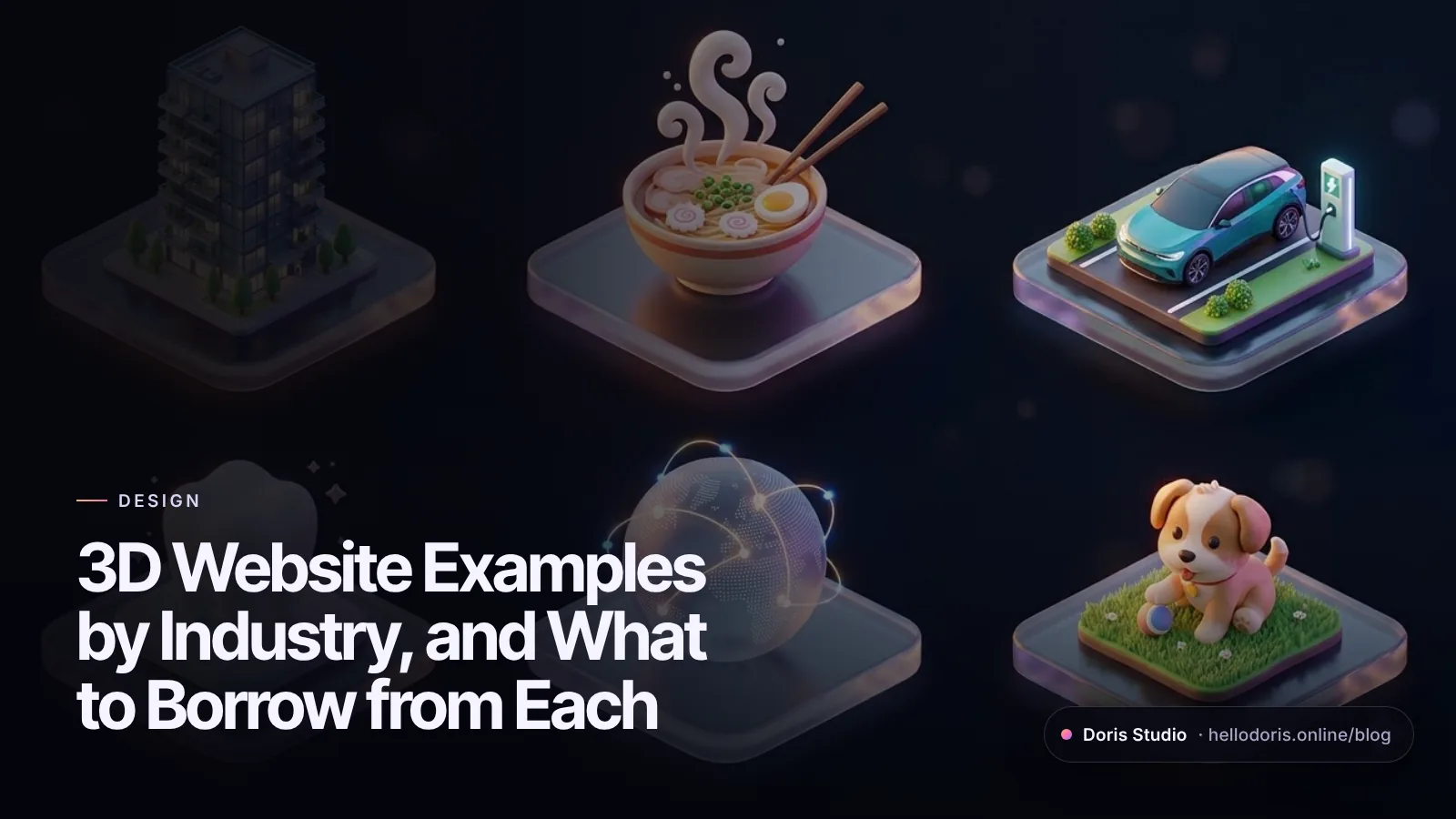
The best 3D website examples use 3D to do one job a photo can’t: let a buyer rise through a tower that isn’t built yet, build a ramen bowl before ordering it, or see inside a tooth before treatment. Below are 28 interactive 3D website examples from the Doris Studio Lab, grouped by industry, each with the business goal behind it and the idea worth borrowing for your own site.
One note before the tour: every Lab site is a concept for an invented brand, designed and built by our studio to show what’s possible. All 28 run live in the browser on Three.js, and every 3D object in them, from the car to the bouquet, is generated in code rather than loaded as a model file. For live client and own-brand work, see our 3D websites.
Key takeaways
- Good 3D does one job a photo can’t: it shows what is hidden, what isn’t built yet, or what the customer would choose.
- Tie the 3D to the action you want: book, order, configure or inquire.
- Build-it-yourself scenes suit food, drinks and flowers. Exploded views suit products. Living environments suit travel and hospitality.
- Keep the words in HTML and let scrolling stay normal, so the site stays fast, readable and findable.
Real estate and architecture
Aurelia Residences (condo tower, Miami). As you scroll, the camera rises along a 50-story waterfront tower from dawn to night. Floors light up by collection, a floor-plan picker flies you to your floor, and an aerial night map pins the neighborhood. The goal is selling homes that don’t exist yet: buyers can’t tour the building, but they can find their floor and their view.
Stratum Architects (architecture firm). Basswood-style massing models of housing, a library and a timber pavilion drop into place block by block, under the Seattle sun with moving shadows. Visitors can drag the sun themselves, which shows a prospective client how the firm thinks about light before the first meeting.
Borrow this: if you sell space, let visitors move through it and claim their part of it. More in our guide to real estate website design.
Restaurants, cafés and food brands
Food is a natural fit for 3D, because the product changes as it’s made and customers love to choose.
- Ninth Bowl (ramen counter). One real-time 3D bowl carries the whole page. Tap a broth and it pours in, toppings drop in as you scroll, and a build-your-bowl panel keeps a running ticket. The menu becomes the reservation pitch.
- Blister & Basil (Neapolitan pizzeria). The pie gets made as you scroll: the dough stretches, sauce spirals on, mozzarella melts and it bakes against a 90-second timer. Then you build your own. It tells a craft story a menu line can’t.
- Stackyard (smash burgers). A double burger explodes into ten labeled layers, drops back together with a squash, then rebuilds live as you add patties, cheese and bacon, on a page built around pickup orders.
- Slowpearl (bubble tea). Milk pours and swirls into fresh tea, pearls ride the straw, and a configurator rebuilds the drink as you change it.
- Ember & Oak (wood-fire restaurant). Press and hold to stoke a real-time hearth, then the camera glides down the chef’s counter to each course. It sells atmosphere, the hardest thing to photograph.
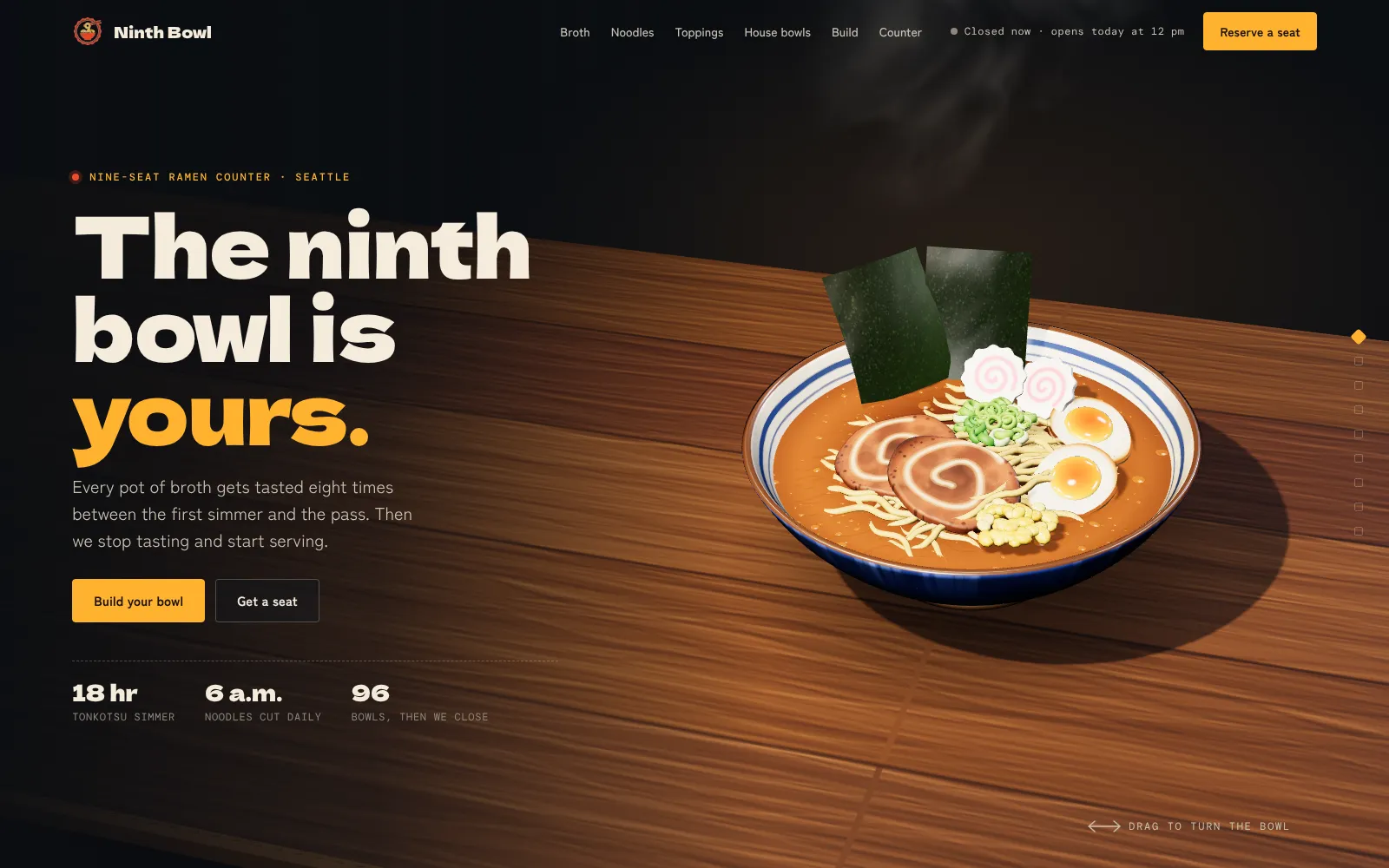
Borrow this: let people build the dish they’re about to order, and put the order or reservation button where the build ends. See restaurant website design.
Health, wellness and beauty
- Lumen Dental (family and cosmetic dentist). A glossy molar splits open into enamel, dentin and pulp, then walks through cleanings, aligners, implants and whitening. Seeing what happens inside a tooth makes treatment less intimidating before anyone books.
- Maison Lune (skin salon). One iridescent serum drop refracts the night sky, becomes a dropper bottle and phases like the moon. Point at a treatment on the menu and the drop changes to match, so the signature product becomes the brand.
- Halden Baths (bathhouse). You walk the circuit in real time: an arch-lit pool hall, a cedar sauna where you can pour water on the stones, a cold-plunge timer and a dimmable float room. First-timers know what to expect before they arrive.
- Repline (home-workout app). A 3D mannequin squats, lunges and planks while the page shows how the phone’s camera coach counts reps and checks form. Watching it work answers “does this actually work?” before the free trial.
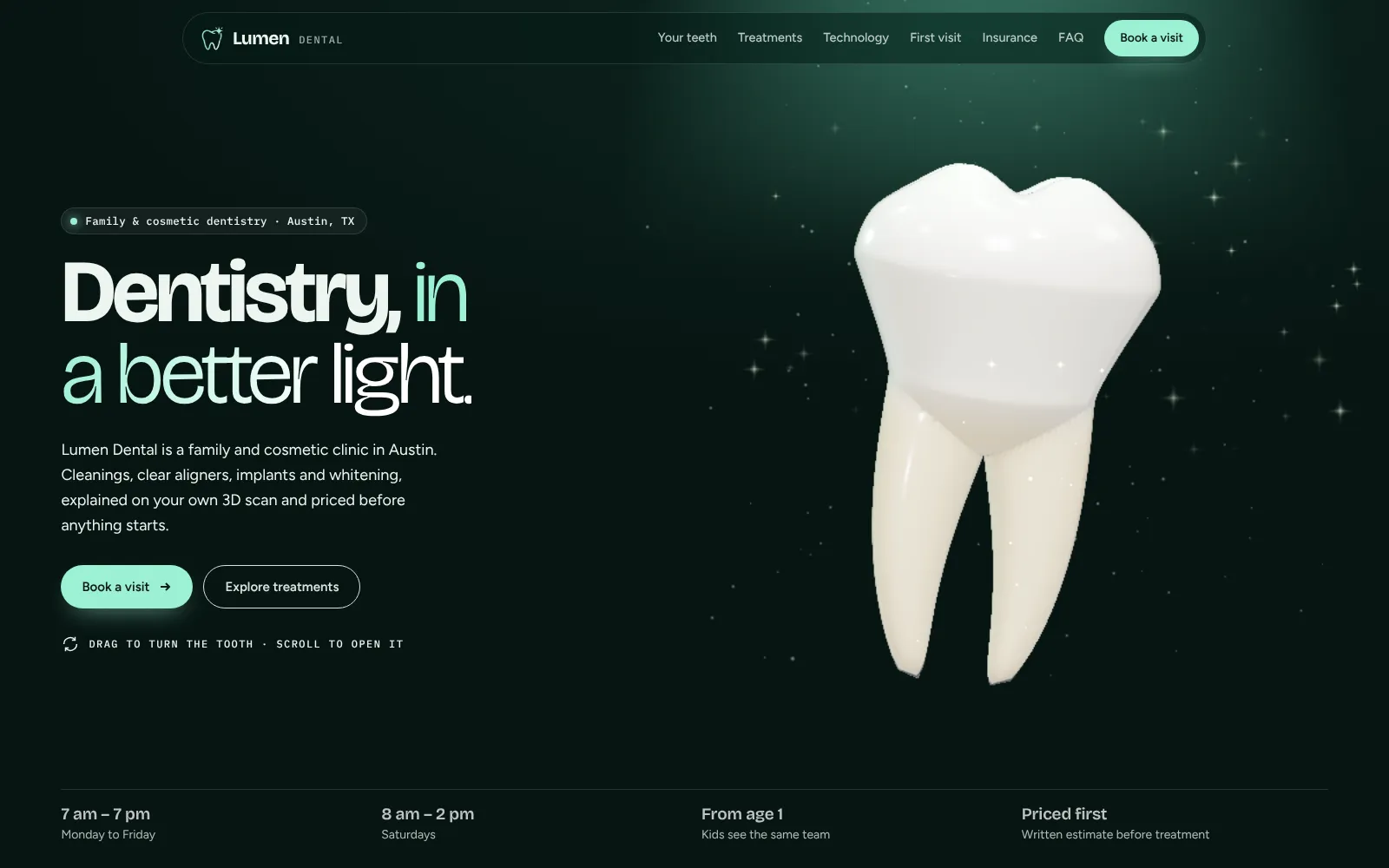
Borrow this: use 3D to show the part people can’t see or feel nervous about, then lead straight to booking.
Automotive and physical products
Baymard Institute found that 56% of users’ first action on a product page was to start exploring the product images. A product people can turn, open up and recolor gives that first look much more to explore.
- Voltara Motors (electric crossover). A low-poly car turns in a reflective studio, goes x-ray to show its battery, cabin and sensors, and repaints in whatever color you pick in the configurator, which ends at a test-drive booking.
- Pulse Runners (sneaker drop). A running shoe built entirely in code explodes into foam, carbon plate and upper as you scroll. Five colorways repaint the shoe and the page, and a countdown runs to the draw.
- Nightglass (gaming keyboard). Type on your own keyboard and each key presses its twin on the 3D board. Scrolling takes it apart into seven layers, and a sound test synthesizes the switches in the browser.
- Kilnhouse (ceramics studio). One vase morphs from wet clay to a glowing kiln, re-glazes live, and changes shape as you sculpt your own commission.
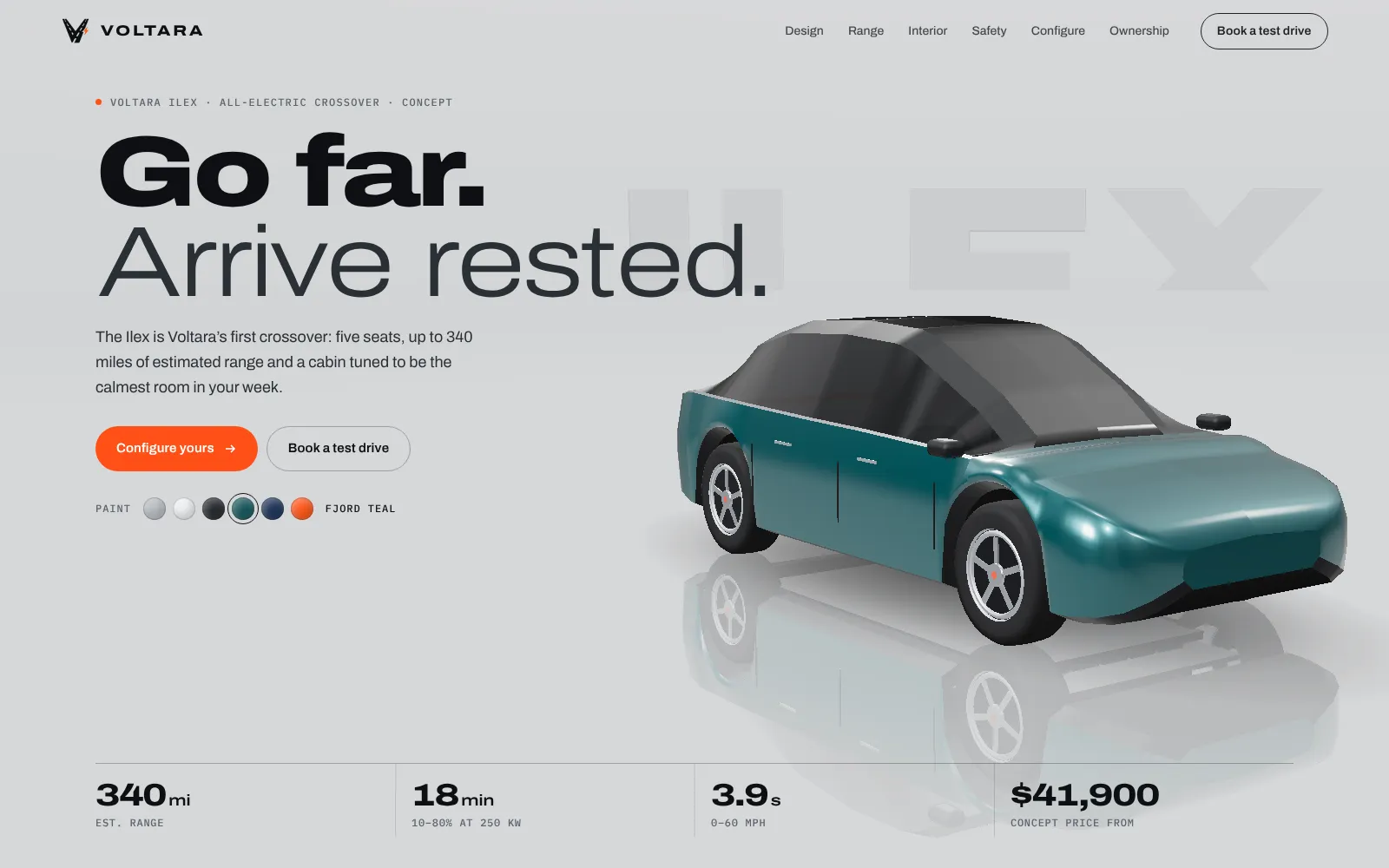
Borrow this: an exploded view sells the engineering; a live color picker sells ownership. The same pattern drives the colorway picker in Pulse Runners and the build-a-stack panel in Stackyard, and our guide to 3D product configurators goes deeper.
Travel, hospitality and the outdoors
Saltmarsh Retreat (tidal-marsh hotel, Maine). You drift from open sea to the lodge, drag the tide to flood the marsh, watch your chosen room light up on the lodge and switch the landscape between four seasons. It sells a place that keeps changing, which is a reason to come back.
Cairnway (guided mountain weekends). A live 3D topographic map walks you along a 21-mile loop from the Friday trailhead to a summit sunrise, with elevation, mileage and time updating as you scroll. It answers “can I really do this?” before people hold a spot.
Borrow this: let visitors change the conditions of the place you’re selling: the tide, the season, the time of day.
Software, fintech and B2B services
Abstract products are hard to picture. 3D gives them a shape.
- Plotwise (down-payment planner). Your savings plan becomes a model: a brick house builds itself as you save, and moving a slider moves the month you get the keys.
- Ampline (energy software). A night-lit 3D service territory reshapes as you scroll, from a glowing demand curve at dusk to a storm, with a battery-dispatch replay you can scrub hour by hour.
- Harborlink (freight forwarder). A dotted globe with animated shipping lanes turns to each region, next to a tracking demo and a quote tool that draws your lane.
- Gatherfield (event logistics). A floating 3D site model holds a badge you name and swing, a night check-in replay and a hall that fills as you price.
- Fold & Field (design agency). One hinged sheet of paper folds into every chapter, ending as a paper plane that carries your brief.
- Lowtide Audio (recording studio). A field of 25,600 points you can tap to play notes morphs into a spectrum disc, a speaker dome and a microphone.
Borrow this: turn what your product produces, whether a date, a route or a schedule, into an object visitors change with their own inputs.
Education and games
- Lumio Learning (live online school, ages 8 to 14). Four low-poly planet-islands orbit a glowing core, and scrolling flies you from math peaks to a science lagoon, a coding grove and an art harbor. Each subject becomes a place kids want to visit, which is the pitch to parents booking a trial class.
- Comet Courier (browser game). Scrolling flies a courier ship past low-poly planets, and Play opens a full-screen one-tap game that works with mouse, keyboard or touch. The marketing page and the game are the same thing.
We’ve built this idea at full scale for a client: Playwatch Academy is a 3D learning world for PreK to Grade 6, where a guide named Gabby flies kids between learning islands. See more in our game room and our guide to educational browser games.
Borrow this: make the curriculum or the game map the navigation.
Pets, retail and gifts
- Biscuit & Bark (dog daycare club). An original 3D pup you can boop, recolor and photograph chases a ball through a 7-to-7 day, takes a bubble bath and naps under the moon, walking owners through the daycare routine.
- Posywick (same-day florist). A bouquet ties itself as you scroll, restyles for each occasion and settles into a vase, and a configurator rebuilds it stem by stem.
- Plumpling (designer toys). The blind-box unboxing happens in 3D: spin, pop, peel and meet, plus a box you can shake to see the odds.
Borrow this: recreate the moment customers love most, whether the unboxing, the bouquet or the happy dog, and let them play with it.
How to choose the right 3D idea for your website
Match the 3D idea to your business goal
| Your goal | 3D idea | Lab examples |
|---|---|---|
| Sell something that isn’t built yet | A model visitors move through and pick from | Aurelia Residences, Stratum Architects |
| Let customers customize, then order | A build-it-yourself scene with a live total | Ninth Bowl, Stackyard, Slowpearl, Posywick |
| Explain what’s hidden | An exploded or cutaway view | Lumen Dental, Voltara Motors, Pulse Runners, Nightglass |
| Sell a feeling or a place | A living environment visitors can change | Saltmarsh Retreat, Halden Baths, Ember & Oak |
| Make data or logistics tangible | A live map, globe or site model | Harborlink, Ampline, Cairnway, Gatherfield |
| Make a number personal | An object that grows with the visitor’s inputs | Plotwise |
| Get people to play and return | A world or a game | Lumio Learning, Comet Courier |
| Be remembered and shared | A character people can poke | Biscuit & Bark, Plumpling |
A checklist before you borrow an idea
- The 3D shows something a photo can’t, and it leads to one clear action: book, order, configure or inquire.
- Every headline, price and paragraph is real HTML. Google indexes the rendered HTML, so words drawn inside a 3D canvas won’t be found.
- Scrolling stays normal. In Nielsen Norman Group’s usability testing, the majority of participants were at least mildly disoriented by scrolljacking, which changes the speed or direction of scrolling. Our Lab scenes follow the page’s native scroll instead of taking it over.
- Motion can be calmed. Under WCAG, moving content that starts on its own, lasts more than five seconds and runs alongside other content needs a way to pause, stop or hide it. The scene should also respect the visitor’s reduced-motion setting.
- The headline and main button appear before the 3D finishes loading, and the page still works on a device that can’t run WebGL.
- It runs smoothly on a mid-range phone, not just your laptop. Our guide to fast 3D websites covers how.
Wondering what one of these ideas would take for your business? Start with how much a 3D website costs, see what’s included in our 3D website design service, or tell us about your business. We’ll build a free concept from your own content first, so you see your 3D website before you pay for it.
Frequently asked questions
What is a 3D website?
A 3D website shows real-time 3D graphics in the browser, usually with WebGL and a library like Three.js, alongside normal HTML content. Visitors can turn, scroll through or play with the scene without installing anything. The best ones use the 3D to explain or sell something a flat image can't.
What are some good examples of 3D websites?
Strong examples tie the 3D to a business goal: a condo tower you rise through floor by floor, a ramen bowl you build before ordering, a tooth that opens up to explain treatment, or an electric car you can x-ray and repaint. All four are concepts in the Doris Studio Lab (Aurelia Residences, Ninth Bowl, Lumen Dental and Voltara Motors) and open in any modern browser.
Which industries benefit most from a 3D website?
Industries where the product is visual, customizable or hard to see: real estate and architecture, restaurants and food brands, cars and consumer products, travel and hospitality, clinics and beauty, and education. If your visitors mostly need one fast task, such as a phone number or opening hours, a clean 2D site is usually the better choice.
Are 3D websites bad for SEO?
Not when every heading and paragraph is real HTML next to the 3D scene. Google indexes the rendered HTML, so words drawn inside a 3D canvas won't be found. Speed matters too, so the text and buttons should load before the 3D.
Do 3D websites work on phones?
Yes, when they are designed for touch first and tuned for phone graphics chips: lightweight or code-built 3D, capped resolution and a plain fallback for devices that can't run WebGL. Test any 3D site on a mid-range phone, not only on a laptop.
How much does a 3D website cost?
It depends on how much of the site is 3D and what the 3D has to do, from a single interactive hero to a configurator or a walkable world. Doris Studio quotes every 3D project after a short call and shows you a free concept first; modern 2D redesign packages start at $500.
Sources

Founder and creative director of Doris Studio. Doris designs and builds immersive 3D websites, brand sites, browser games and learning worlds for clients in the US and worldwide, and leads creative at SentryX. About Doris · See the Lab